


Knowledge / Transport and handover
Organising the Last Mile of Pharmaceutical Cold Chain Shipping
Temperature protection must last until the intended handover and storage of the goods. On the last mile, an unavailable recipient, delayed delivery or frequent opening of a delivery-round box can extend this period or affect temperature. Plan for these cases before the first shipment.
Practical guidance
Define what happens after a failed delivery and how the goods remain protected until they enter storage.
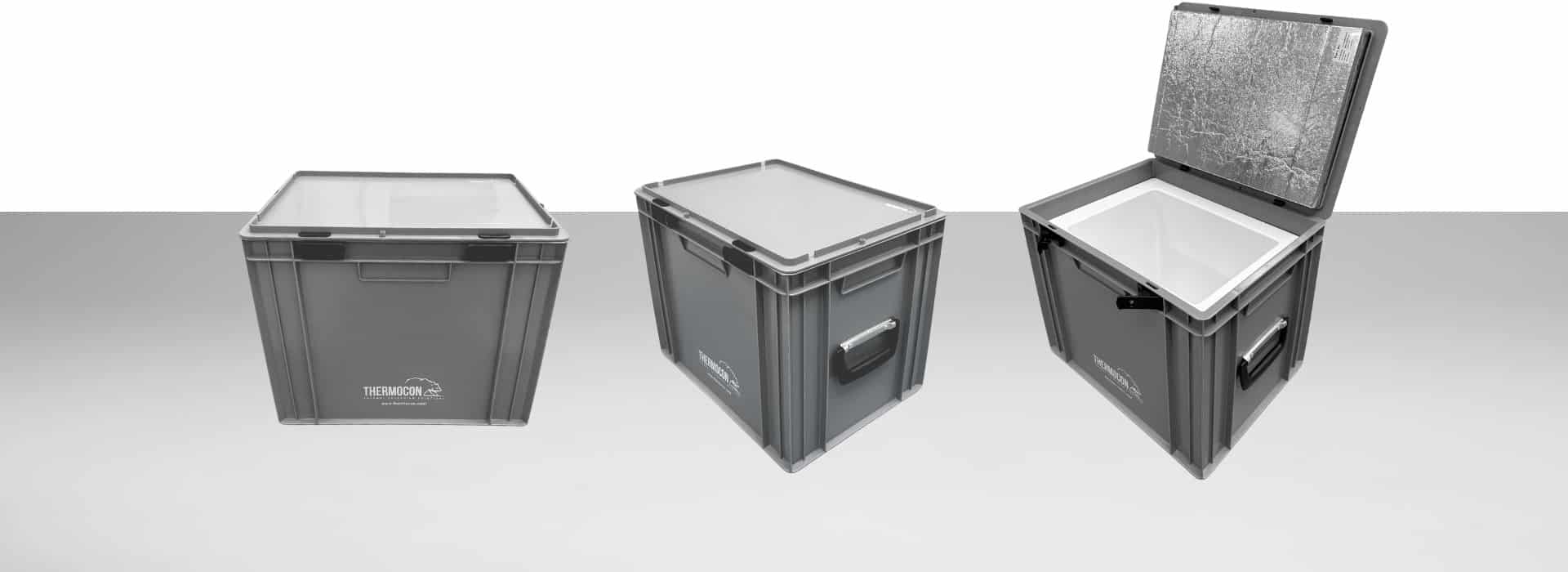
THERMOCON product view of the Medi Line, open and closed.
In this guide
- Define who receives and stores the goods
- What must be agreed in advance for failed delivery
- A delivery-round box faces different demands from a sealed parcel
- Example: the recipient is absent at the delivery attempt
- What a US study shows about unprotected shipments
- Identify recurring delivery problems from the data
- Agree returns and reuse with the recipient
- Create concise delivery instructions for everyday use
Define who receives and stores the goods
Clarify the recipient, receiving point and subsequent storage location. A central hospital receiving department works differently from an individual clinical study delivery. Product requirements and permitted supply arrangements must be clarified for the specific process.
Agree receiving hours, available contact persons and storage instructions. A delivery confirmation alone does not establish whether the goods were subsequently stored under the prescribed conditions.
What must be agreed in advance for failed delivery
- Whom does the delivery driver inform if nobody is available?
- How long may the shipment continue waiting or travelling?
- Under which conditions is a second delivery attempt permitted?
- Which suitable intermediate storage arrangement is planned?
- When does quality assurance decide on further action?
Leaving the parcel unattended or with a neighbour must not be improvised. The alternative procedure must be specified for the goods and delivery process. Required timings and packaging information are established when preparing and packing the shipment.
A delivery-round box faces different demands from a sealed parcel
An individual parcel remains closed until handover. A delivery-round box, by contrast, is opened at several stops and gradually emptied. Each removal changes the product quantity and temperature conditions.
Define the number and duration of openings, removal sequence and remaining payload. A test of a continuously closed shipper is not automatically sufficient for this process. An intermediate stop in a temperature-controlled vehicle does not restore the packs to their original state either.
Whether the box is collected after the round and reused is part of the single-use or reusable packaging concept.
Example: the recipient is absent at the delivery attempt
The delivery driver informs the agreed contact and documents the time and shipment status. That contact follows the approved procedure to decide whether another delivery, intermediate storage or return is possible.
This requires shipping duration, packaging configuration and the necessary temperature data to be available. A single current measurement does not show the preceding history. If suitability is unclear, the goods are secured and assessed under the defined quality procedure.
Also specify a reachable contact and the procedure without a wireless connection. Instructions that work only through an unavailable app do not resolve the situation on site.
What a US study shows about unprotected shipments
In 2019/2020, Chowdhury and co-authors studied temperature data loggers in ordinary shipping envelopes on a round-trip route in the US. Of 36 shipments, 35 could be evaluated. Published in 2023, the study documents exposure to both high and low temperatures; in this trial, a faster shipping service did not replace temperature protection.
The study examined neither qualified thermal packaging nor the efficacy of medicines. Periods after delivery were not evaluated. Its results therefore do not represent a failure rate for German pharmaceutical shipments. Your own shipping assessment must also cover the time until the goods actually enter storage.
Identify recurring delivery problems from the data
Associate event times and temperature data with the shipment, packaging version and delivery round. This can reveal, for example, whether certain receiving points are more frequently closed or logger data are missing on particular rounds.
Record a few clearly defined metrics: the proportion of successful first deliveries, time until temperature data are available and the proportion of temperature excursions with a completed assessment. Agree with those responsible when an unusual result should trigger a process change.
Source: Pharma IQ: Tackling Temperature Excursions – Interview with Saddam Huq, GSK (2018).
Agree returns and reuse with the recipient
For regular rounds, reuse with organised collection can be suitable. For one-off or dispersed recipients, single-use packaging may involve less administration. For reuse, clarify return, cleaning, inspection and renewed preparation before assuming a particular number of uses.
THERMOCON Medi Line is a product option for suitable reusable applications. Whether a version fits depends on temperature range, payload and openings. For goods at +15 to +25 °C, the CRT guide explains the selection of cooling elements.
Source: THERMOCON: Medi Line.
Create concise delivery instructions for everyday use
Instructions for delivery staff should include the receiving point, contact person, time limits, storage guidance and the procedure for problems. Details of climate chamber test development do not belong in these work instructions.
Temperature monitoring must suit the product and process. Assign measurements clearly to the shipment, container and period. If an excursion occurs, preserve the data and involve the responsible team; the current display alone does not determine whether the goods are usable.
Sources
- Chowdhury et al.: Evaluation of temperature excursions from USP 〈659〉 recommendations during mail transit (2023). JAPhA 63, 847–852; DOI 10.1016/j.japh.2023.02.002. US shipping trials using uninsulated envelopes.
- Pharma IQ: Tackling Temperature Excursions – Interview with Saddam Huq, GSK (2018). Interview from 2018, PDF pages 4–10: experience with temperature excursions and responsibilities.
- THERMOCON: Medi Line. THERMOCON Medi Line reusable systems.
Sources checked on 12 September 2026.
Select a reusable box for your delivery round
Describe receiving hours, the number and duration of openings, and the procedure after failed delivery. This allows assessment of which Medi Line configuration suits your round.